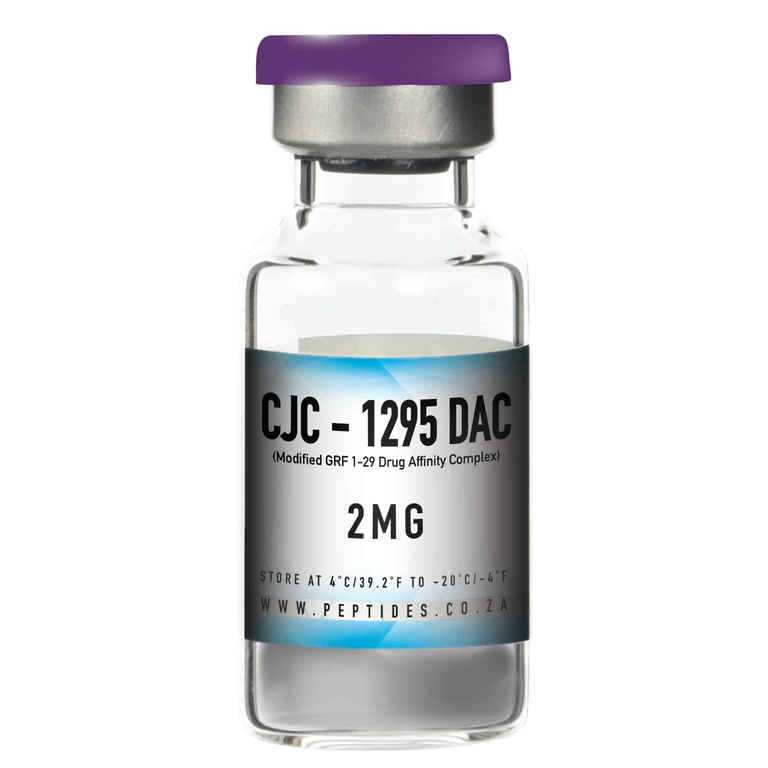
CJC-1295 is a long-acting analogue of growth hormone-releasing hormone (GHRH). The name properly refers to a 29-residue, maleimide-bearing drug-affinity-complex analogue designed to form a covalent conjugate with serum albumin. “CJC-1295 without DAC” is a different reagent and must not be treated as interchangeable.
What Are the Key CJC-1295 Research Specifications?
| Specification | Research record |
|---|---|
| Compound | CJC-1295 |
| Category | hgh |
| Listed purity | >99% |
| Molecular weight | Form-dependent; see identity section |
| Intended use | Laboratory research only |
What Is the Chemical Identity of CJC-1295?
The original CJC-1295 is a tetrasubstituted hGRF(1–29) analogue with a C-terminal lysine carrying a maleimidopropionamide group. PubChem reports an unconjugated molecular mass of 3647.2 g/mol. Its maleimide reacts with the free thiol of albumin Cys34 in vivo; the albumin conjugate is therefore much larger and has different pharmacokinetics.
Products called “CJC-1295 no DAC” generally refer to modified GRF(1–29) lacking the albumin-reactive group. That material cannot reproduce the defining albumin-conjugation mechanism of CJC-1295.
How Was CJC-1295 Developed and How Does It Work?
CJC-1295 activates the GHRH receptor on pituitary somatotroph models, coupling through Gs to cAMP and GH release. The analogue emerged from a programme that used in vivo albumin bioconjugation to extend peptide exposure. In early human studies, the DAC form produced prolonged increases in measured GH and IGF-1, consistent with its extended exposure; those data should not be extrapolated to the no-DAC analogue.
How Should a CJC-1295 Study Be Designed?
State DAC status in the title, methods and raw-data metadata. For receptor studies, include native GHRH(1–29) and a no-DAC analogue as comparators. For albumin-dependent experiments, measure conjugation directly by intact-protein MS, peptide mapping or a validated thiol-reactivity assay rather than inferring it from a delayed phenotype.
How Should CJC-1295 Be Handled and Verified?
Maleimides can hydrolyze and can react with unintended nucleophiles. Protect the reagent from moisture, minimize time in reactive buffers and document the buffer pH and albumin source. Confirm intact mass and maleimide functionality; standard reversed-phase HPLC cannot by itself establish conjugation competence. Use single-use aliquots and avoid repeated freeze-thaw cycles.
Which Sources Support CJC-1295 Research?
- Jette et al., identification of CJC-1295 as an albumin-bioconjugating GRF analogue, Endocrinology (2005), PMID 15817669.
- Teichman et al., pharmacokinetic and pharmacodynamic study of CJC-1295, JCEM (2006), DOI: 10.1210/jc.2005-1536.
How Can CJC-1295 Results Be Interpreted Without Overclaiming?
Begin interpretation with a falsifiable question and a predeclared primary readout. For CJC-1295, chemical identity, target engagement and downstream phenotype are separate layers. A change in migration, viability or gene expression does not by itself prove the proposed molecular target. Report negative and null findings, not only the largest response. Show individual observations, biological replicates and uncertainty intervals, and identify whether replication means a new well, a new culture, a new animal or a new day.
A citable CJC-1295 result states the species, cell line or biochemical system; exact molecular form; concentration and exposure; comparator; assay method; and statistical unit. Confirm that vehicle, pH, osmolality or precipitation did not create the phenotype. Conclusions should stay at the level tested: in vitro activity is not evidence of organism-level efficacy, and an animal phenotype is not a human claim.
What Would a Rigorous CJC-1295 Evidence Package Include?
A primary CJC-1295 research record should make four elements independently auditable. First, the identity package should include the exact sequence or structure, terminal and side-chain modifications, counterion or ester, intact-mass confirmation, chromatographic method, content assignment and relevant impurity tests. Second, the exposure package should demonstrate stock recovery, solution stability and the concentration that actually reached the assay. Nominal vial mass alone is not an exposure measurement.
Third, mechanism should be demonstrated near the proposed target. For CJC-1295, that means using the receptor, enzyme, binding partner or pathway described in the article with a blocking, knockout or orthogonal-perturbation control. Downstream endpoints should follow a plausible time course and should survive an independent assay method. Fourth, the phenotype package should include matched vehicle, positive and negative controls, biological replication and transparent reporting of exclusions.
For hgh research, cross-study comparisons are strongest when laboratories use the same molecular form and report results on a molar basis. Differences in formulation, serum binding, species, receptor density and sampling time can reverse an apparent rank order. A literature summary should therefore distinguish direct biochemical evidence, controlled cell data, animal findings and human observations instead of presenting them as one evidence tier. This framework makes CJC-1295 content useful for protocol planning while keeping every conclusion traceable to the experiment that supports it. Archive the protocol, raw data and lot documentation so another laboratory can repeat the comparison without reconstructing hidden assumptions.
Before publication, test robustness by changing one plausible nuisance variable—operator, day, serum lot, plate format or analytical column—while holding the CJC-1295 hypothesis constant. Report whether the conclusion survives that challenge. This small validation step often reveals matrix effects, adsorption or batch drift that a technically replicated single run cannot detect.
Is CJC-1295 for Research Use Only?
CJC-1295 is supplied for laboratory research only. It is not for human or veterinary use.
Browse Growth Hormone Peptides
What Are Common Questions About CJC-1295?
What is CJC-1295?
CJC-1295 is a long-acting analogue of growth hormone-releasing hormone (GHRH). The name properly refers to a 29-residue, maleimide-bearing drug-affinity-complex analogue designed to form a covalent conjugate with serum albumin. “CJC-1295 without DAC” is a different reagent and must not be treated as interchangeable.
How should researchers verify CJC-1295?
Confirm the exact molecular form on the lot certificate and pair chromatographic purity with an orthogonal identity method such as mass spectrometry or NMR. Use the molecular weight, counterion and content stated for that verified form when calculating molarity.
Is CJC-1295 intended for human use?
CJC-1295 is listed for controlled laboratory research only. It is not intended for human or veterinary use.