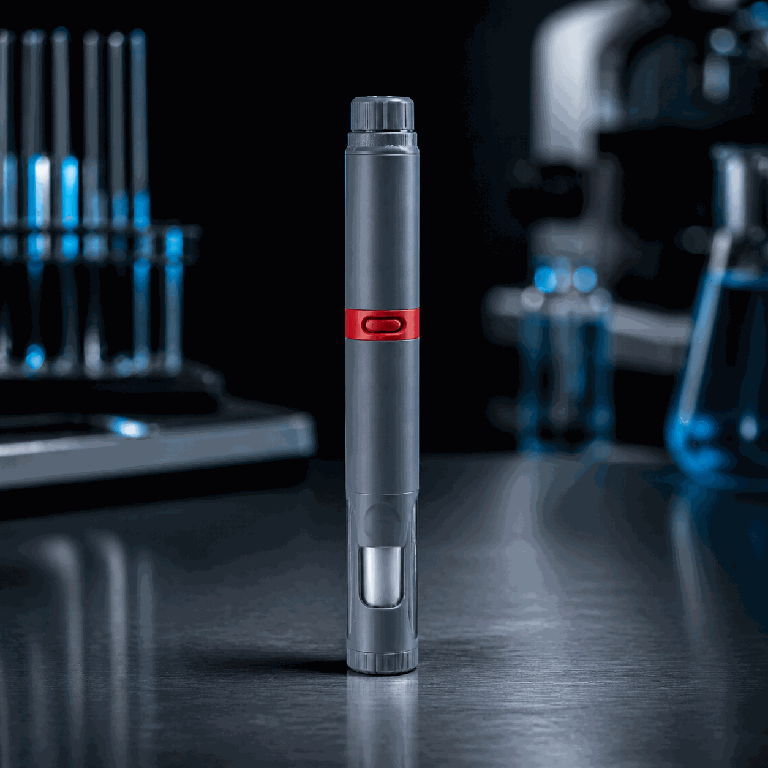
Liraglutide is a GLP-1 receptor agonist studied in laboratory research for its potential role in metabolic regulation. It is a synthetic analogue of glucagon-like peptide-1 (GLP-1) that is studied in research on glucose metabolism and incretin signaling.
What Are the Key Liraglutide Research Specifications?
| Specification | Research record |
|---|---|
| Compound | Liraglutide |
| Category | metabolic |
| Listed purity | >99% |
| Molecular weight | 3.7 kDa |
| Intended use | Laboratory research only |
What Is the Chemical Structure of Liraglutide?
Liraglutide is a synthetic analogue of GLP-1 with a fatty-acid side chain that extends its stability. It is a peptide with a molecular weight of approximately 3.7 kDa.
How Should Liraglutide Analytical Quality Be Verified?
For Liraglutide, HPLC area purity should be read together with an orthogonal identity result. The Liraglutide lot record should specify the molecular form, chromatographic method and intact-mass or spectroscopic confirmation. HPLC area alone does not establish Liraglutide content, counterion, water, residual solvent or endotoxin; those variables can alter molar calculations and biological assays.
What Does Current Research Establish About Liraglutide?
Liraglutide is a GLP-1 analogue with Lys26 acylated through a glutamate spacer to palmitate and Lys34 replaced by Arg. Albumin binding and delayed absorption change exposure without changing the core GLP-1 receptor mechanism.
A citable Liraglutide evidence unit identifies the model, concentration, comparator, target-proximal readout and analytical identity. Liraglutide results from animals, isolated cells and receptor assays answer different questions; they should not be collapsed into a medical claim or a single undifferentiated evidence tier.
What Should Researchers Report When Studying Liraglutide?
For Liraglutide, state the receptor species, expression level, assay readout and exposure time. Compare receptor activities in matched cellular backgrounds before interpreting whole-animal metabolic endpoints. For acylated peptides, document albumin or serum concentration because protein binding changes free exposure. Verify the Liraglutide sequence, lipidation site, counterion, intact mass and monomer content; use low-binding tubes, single-use aliquots and a stability check in the final assay matrix. Include vehicle, receptor-negative and pathway-inhibition controls.
Where Can Researchers Verify Liraglutide Sources?
Use PubMed’s indexed Liraglutide literature to locate primary studies and PubChem’s Liraglutide records to cross-check structures and identifiers. Match every citation to the exact sequence, ester, salt or formulation documented for the lot; a shared trade name does not prove chemical equivalence.
How Can Liraglutide Results Be Interpreted Without Overclaiming?
The strongest Liraglutide evidence connects identity to mechanism to phenotype in that order. For Liraglutide, receptor pharmacology, protein binding and whole-system metabolism are separate layers. A downstream change in body composition or glucose does not by itself identify which receptor produced it. A useful study includes an orthogonal analytical identity check, a target-dependent perturbation and a second assay that measures the same biology by a different method. This design makes a positive result easier to reproduce and a negative result easier to interpret.
For citation-ready Liraglutide reporting, provide raw concentration units, biological replicate counts, prespecified exclusions and the exact time point. Separate exploratory endpoints from confirmatory ones. If exposure was not measured, describe potency as nominal rather than intracellular or free concentration. Limit the conclusion to the model used; avoid converting a pathway observation into a claim about clinical benefit.
Is Liraglutide for Research Use Only?
Liraglutide is supplied for controlled laboratory research only. It is not intended for human or veterinary use. Browse Metabolic Peptides
What Are Common Questions About Liraglutide?
What is Liraglutide?
Liraglutide is a GLP-1 receptor agonist studied in laboratory research for its potential role in metabolic regulation. It is a synthetic analogue of glucagon-like peptide-1 (GLP-1) that is studied in research on glucose metabolism and incretin signaling.
How should researchers verify Liraglutide?
Confirm the exact molecular form on the lot certificate and pair chromatographic purity with an orthogonal identity method such as mass spectrometry or NMR. Use the molecular weight, counterion and content stated for that verified form when calculating molarity.
Is Liraglutide intended for human use?
Liraglutide is listed for controlled laboratory research only. It is not intended for human or veterinary use.