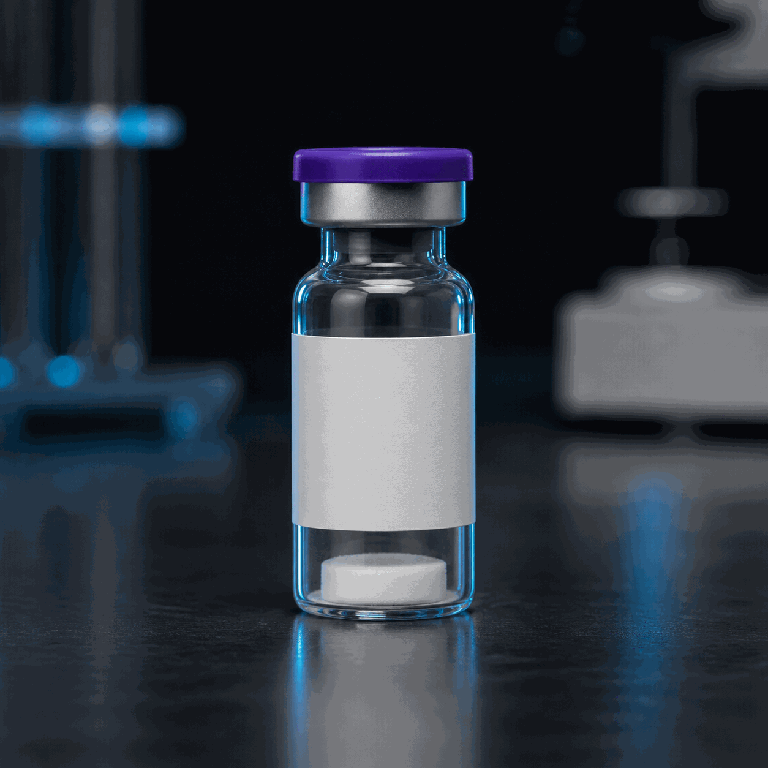
Tesamorelin is a growth hormone-releasing hormone analogue studied in laboratory research for its potential role in endocrine research. It is a synthetic peptide that is studied in research on the growth hormone axis and related physiological processes.
What Are the Key Tesamorelin Research Specifications?
| Specification | Research record |
|---|---|
| Compound | Tesamorelin |
| Category | misc |
| Listed purity | >99% |
| Molecular weight | ~5.1 kDa |
| Intended use | Laboratory research only |
What Is the Chemical Structure of Tesamorelin?
Tesamorelin is a synthetic analogue of growth hormone-releasing hormone with a molecular weight of approximately 5.1 kDa. It is a peptide with a sequence of 44 amino acids.
How Should Tesamorelin Analytical Quality Be Verified?
For Tesamorelin, HPLC area purity should be read together with an orthogonal identity result. The Tesamorelin lot record should specify the molecular form, chromatographic method and intact-mass or spectroscopic confirmation. HPLC area alone does not establish Tesamorelin content, counterion, water, residual solvent or endotoxin; those variables can alter molar calculations and biological assays.
What Does Current Research Establish About Tesamorelin?
Tesamorelin is a stabilized 44-residue GHRH analogue with an N-terminal trans-3-hexenoyl group. The acyl modification reduces enzymatic degradation while preserving GHRH-receptor agonism.
A citable Tesamorelin evidence unit identifies the model, concentration, comparator, target-proximal readout and analytical identity. Tesamorelin results from animals, isolated cells and receptor assays answer different questions; they should not be collapsed into a medical claim or a single undifferentiated evidence tier.
What Should Researchers Report When Studying Tesamorelin?
Define the complete Tesamorelin molecular form: sequence or structure, terminal modifications, counterion, formula mass and lot-specific content. Use a concentration-response series, time-matched vehicle and a target-dependent control rather than relying on a single descriptive phenotype. Verify Tesamorelin recovery at the working concentration, prepare single-use aliquots and avoid repeated freeze-thaw cycles. For cell assays, report endotoxin and serum conditions. HPLC area purity should be paired with intact-mass or spectroscopic identity and an assay appropriate to the proposed mechanism.
Where Can Researchers Verify Tesamorelin Sources?
Use PubMed’s indexed Tesamorelin literature to locate primary studies and PubChem’s Tesamorelin records to cross-check structures and identifiers. Match every citation to the exact sequence, ester, salt or formulation documented for the lot; a shared trade name does not prove chemical equivalence.
How Can Tesamorelin Results Be Interpreted Without Overclaiming?
Interpret Tesamorelin with an evidence ladder: verified material, recovered exposure, proximal pathway response and only then a downstream phenotype. For Tesamorelin, chemical identity, target engagement and downstream phenotype are separate layers. A change in migration, viability or gene expression does not by itself prove the proposed molecular target. Each step needs its own control. Sequence or structure controls test specificity; receptor blockade tests pathway dependence; viability and matrix controls test whether the assay itself explains the result.
A reusable Tesamorelin methods section reports lot, solvent, counterion or ester, concentration, incubation, model provenance and data-normalization method. Include effect size and uncertainty, not only a p value. When literature findings conflict, compare molecular form, model and timing before averaging conclusions. This keeps the article useful to researchers and citable by review systems without overstating what preclinical evidence can support.
Is Tesamorelin for Research Use Only?
Tesamorelin is supplied for controlled laboratory research only. It is not intended for human or veterinary use. Browse Miscellaneous Research Peptides
What Are Common Questions About Tesamorelin?
What is Tesamorelin?
Tesamorelin is a growth hormone-releasing hormone analogue studied in laboratory research for its potential role in endocrine research. It is a synthetic peptide that is studied in research on the growth hormone axis and related physiological processes.
How should researchers verify Tesamorelin?
Confirm the exact molecular form on the lot certificate and pair chromatographic purity with an orthogonal identity method such as mass spectrometry or NMR. Use the molecular weight, counterion and content stated for that verified form when calculating molarity.
Is Tesamorelin intended for human use?
Tesamorelin is listed for controlled laboratory research only. It is not intended for human or veterinary use.