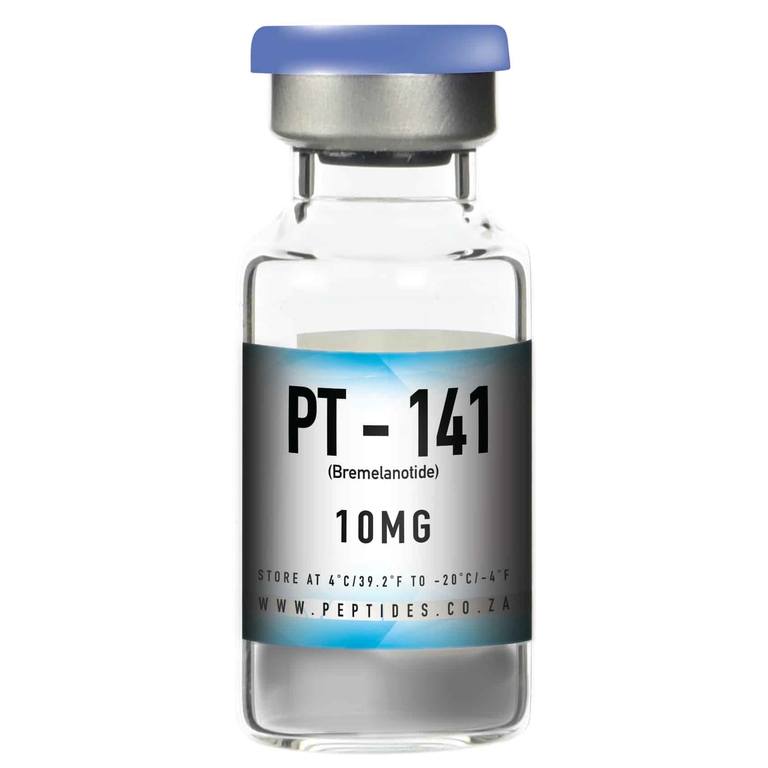
PT-141 is a synthetic peptide studied in laboratory research settings for its potential effects on melanocortin receptor signaling. It is supplied as a lyophilized powder for reconstitution in research protocols.
What Are the Key PT-141 Research Specifications?
| Specification | Research record |
|---|---|
| Compound | PT-141 |
| Category | recovery |
| Listed purity | >99% |
| Molecular weight | Form-dependent; see identity section |
| Intended use | Laboratory research only |
What is PT-141?
PT-141, also known as bremelanotide, is a synthetic analogue of alpha-melanocyte-stimulating hormone (alpha-MSH) that acts on melanocortin receptors. It is studied for its potential effects on melanocortin receptor signaling in experimental models.
The peptide is of interest in research on melanocortin receptor biology and the central nervous system pathways regulated by these receptors. Its receptor selectivity makes it a tool for investigating melanocortin system function.
How Does PT-141 Work in Research Models?
In laboratory models, PT-141 is studied for its potential to activate melanocortin receptors, particularly those expressed in the central nervous system. Research focuses on the downstream signaling pathways and physiological effects of receptor activation.
Research applications focus on:
- Melanocortin receptor activation and signaling
- Central nervous system melanocortin pathways
- Melanocortin system biology
- Receptor selectivity and signaling kinetics
Researchers also study PT-141 in the context of melanocortin receptor selectivity and the central nervous system pathways regulated by these receptors. Its synthetic structure allows investigators to examine how receptor engagement translates into physiological responses in experimental models.
How Should PT-141 Analytical Quality Be Verified?
For PT-141, HPLC area purity should be read together with an orthogonal identity result. The PT-141 lot record should specify the molecular form, chromatographic method and intact-mass or spectroscopic confirmation. HPLC area alone does not establish PT-141 content, counterion, water, residual solvent or endotoxin; those variables can alter molar calculations and biological assays.
What Does Current Research Establish About PT-141?
PT-141 is bremelanotide, a cyclic melanocortin agonist derived from melanotan II. It activates more than one melanocortin receptor; MC4R-linked central signalling is a hypothesis that should be tested in the model used.
A citable PT-141 evidence unit identifies the model, concentration, comparator, target-proximal readout and analytical identity. PT-141 results from animals, isolated cells and receptor assays answer different questions; they should not be collapsed into a medical claim or a single undifferentiated evidence tier.
What Should Researchers Report When Studying PT-141?
Define the complete PT-141 molecular form: sequence or structure, terminal modifications, counterion, formula mass and lot-specific content. Use a concentration-response series, time-matched vehicle and a target-dependent control rather than relying on a single descriptive phenotype. Verify PT-141 recovery at the working concentration, prepare single-use aliquots and avoid repeated freeze-thaw cycles. For cell assays, report endotoxin and serum conditions. HPLC area purity should be paired with intact-mass or spectroscopic identity and an assay appropriate to the proposed mechanism.
Where Can Researchers Verify PT-141 Sources?
Use PubMed’s indexed PT-141 literature to locate primary studies and PubChem’s PT-141 records to cross-check structures and identifiers. Match every citation to the exact sequence, ester, salt or formulation documented for the lot; a shared trade name does not prove chemical equivalence.
What Would a Rigorous PT-141 Evidence Package Include?
A primary PT-141 research record should make four elements independently auditable. First, the identity package should include the exact sequence or structure, terminal and side-chain modifications, counterion or ester, intact-mass confirmation, chromatographic method, content assignment and relevant impurity tests. Second, the exposure package should demonstrate stock recovery, solution stability and the concentration that actually reached the assay. Nominal vial mass alone is not an exposure measurement.
Third, mechanism should be demonstrated near the proposed target. For PT-141, that means using the receptor, enzyme, binding partner or pathway described in the article with a blocking, knockout or orthogonal-perturbation control. Downstream endpoints should follow a plausible time course and should survive an independent assay method. Fourth, the phenotype package should include matched vehicle, positive and negative controls, biological replication and transparent reporting of exclusions.
For recovery research, cross-study comparisons are strongest when laboratories use the same molecular form and report results on a molar basis. Differences in formulation, serum binding, species, receptor density and sampling time can reverse an apparent rank order. A literature summary should therefore distinguish direct biochemical evidence, controlled cell data, animal findings and human observations instead of presenting them as one evidence tier. This framework makes PT-141 content useful for protocol planning while keeping every conclusion traceable to the experiment that supports it. Archive the protocol, raw data and lot documentation so another laboratory can repeat the comparison without reconstructing hidden assumptions.
Before publication, test robustness by changing one plausible nuisance variable—operator, day, serum lot, plate format or analytical column—while holding the PT-141 hypothesis constant. Report whether the conclusion survives that challenge. This small validation step often reveals matrix effects, adsorption or batch drift that a technically replicated single run cannot detect.
Is PT-141 for Research Use Only?
PT-141 is supplied for controlled laboratory research only. It is not intended for human or veterinary use. Browse Recovery Peptides
What Are Common Questions About PT-141?
What is PT-141?
PT-141 is a synthetic peptide studied in laboratory research settings for its potential effects on melanocortin receptor signaling. It is supplied as a lyophilized powder for reconstitution in research protocols.
How should researchers verify PT-141?
Confirm the exact molecular form on the lot certificate and pair chromatographic purity with an orthogonal identity method such as mass spectrometry or NMR. Use the molecular weight, counterion and content stated for that verified form when calculating molarity.
Is PT-141 intended for human use?
PT-141 is listed for controlled laboratory research only. It is not intended for human or veterinary use.